Locked Candidates
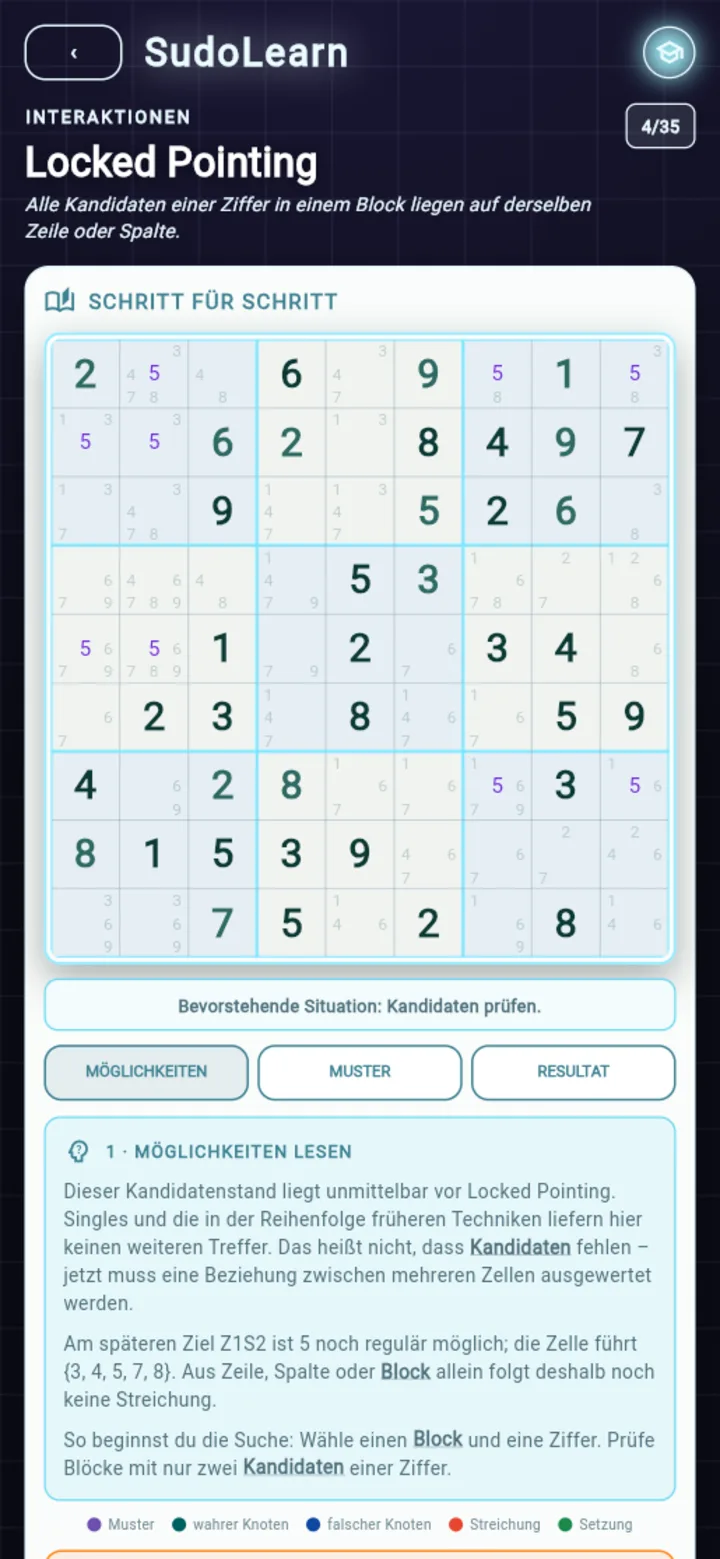
A digit can only sit in one row within a block — so it appears nowhere else in that
row outside the block.
Naked Pair, Triple, Quad
Two, three or four cells share exactly that many digits. For every other cell in the
unit those digits are blocked.
Hidden Pair, Triple, Quad
The same thing, only hidden: the digits sit among other candidates and have to be
uncovered first.
X-Wing
A rectangle in which a digit can only sit at the four corners. It follows that the
digit appears nowhere else in the rows or columns involved.
Swordfish and Jellyfish
The same idea with three or four lines instead of two. Rare, feared — and with a
little practice quite visible.
Finned Fish
A fish with an appendix: the pattern is almost clean, one candidate falls outside —
the conclusion then holds only in part.
XY-Wing and XYZ-Wing
Three cells whose options interlock so that a digit is eliminated elsewhere, no
matter which case turns out to be true.
Skyscraper, Two-String Kite, Empty Rectangle
Three appearances of the same idea: two strong links coupled through a weak one.
Sue de Coq
Two almost complete sets of digits that pin each other down. Regarded among
enthusiasts as one of the most elegant techniques of all.
Remote Pair
A chain of identical pairs that alternately exclude each other — the entry point
into thinking in chains.
X-Chain, XY-Chain, Coloring
Conclusions across several cells: if this digit sits here, then that one sits there —
until a contradiction appears.
AIC
The most general form of chain, alternating strong and weak links. In SudoSuite up to
eight links long — and mandatory in every Titan.